The development of a dam break study is essential to assess the impacts associated with the hypothetical failure of a tailings storage facility, which can have significant consequences for populations and the environment. Anddes has developed extensive experience in conducting dam break studies for mining industry projects in various countries in the region, applying current methodologies and detailed simulations. The following describes some considerations used in 2 tailings storage facilities for a dam break study of mining units located in Mexico.
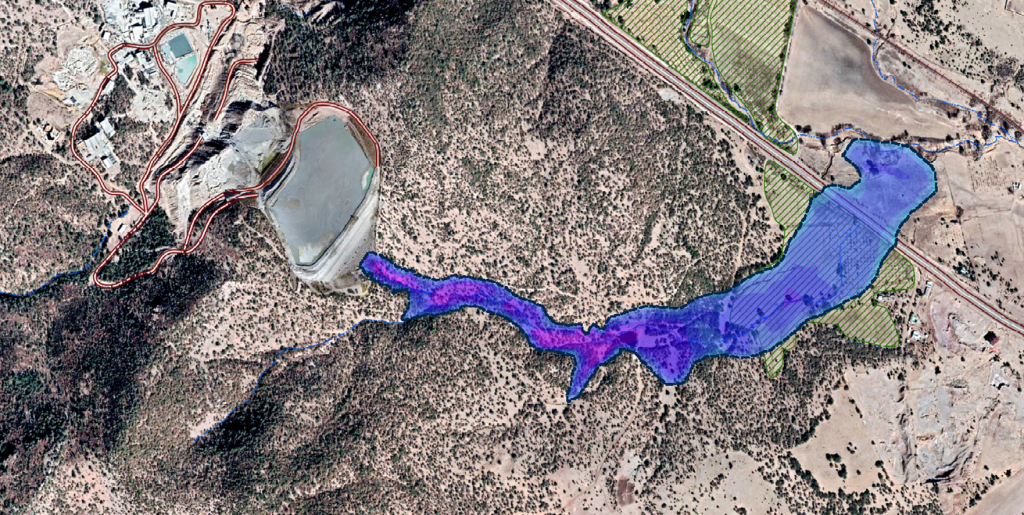
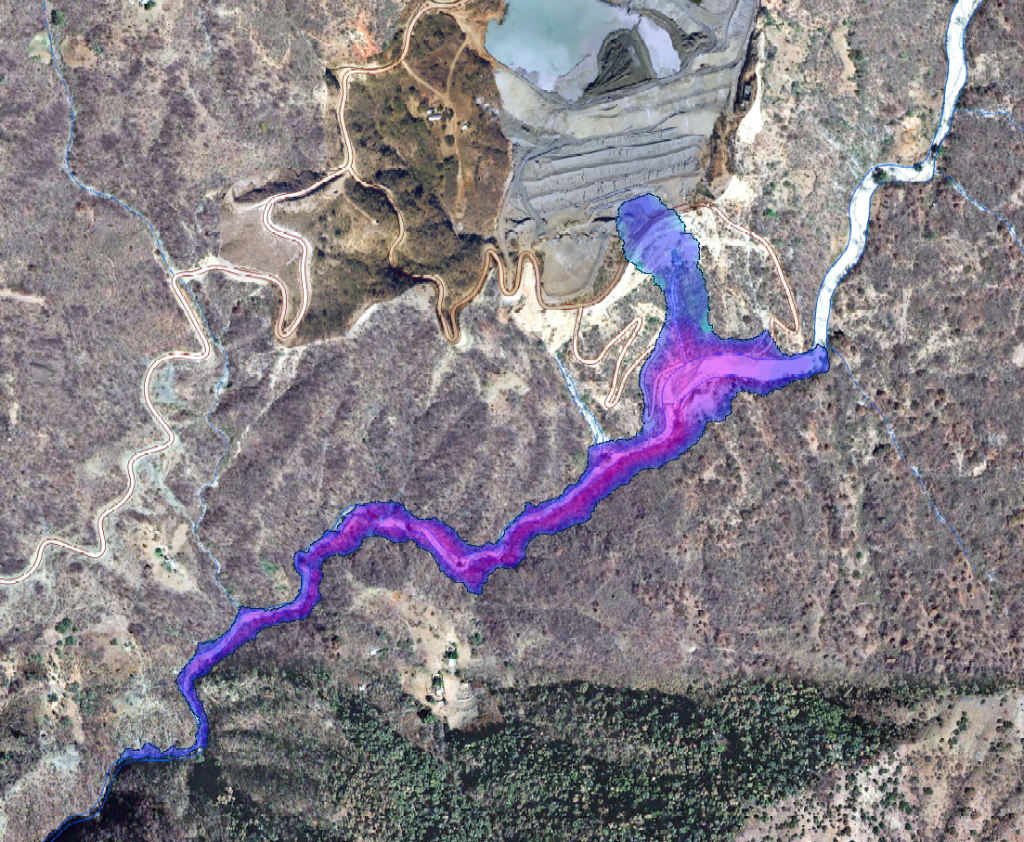
In tailings storage facility 1, a dam built (upstream method) with compacted spigot tailings and a maximum height of 41 m was evaluated; for tailings storage facility 2, a dam raised with compacted semi-dry tailings and a maximum height of 30 m was evaluated. In both tailings storage facilities, failure scenarios were considered for a sunny day and rainy day condition, which allow evaluating the behavior of the tailings under a climatic situation of a sunny day (failure mode due to earthquake, failure in the foundation or other similar) and rainy day (failure mode due to overflow or excess water in the reservoir).
For the simulation of the released tailings, specialized RiverFlow2D software was used with the Mud and Tailings Flow module, which has the ability to simulate the behavior of non-Newtonian flows in complex topographies, considering the rheological parameters of the tailings; likewise, a digital elevation model was built based on the topography with an extension of up to 5 km downstream of the dam where areas that could potentially be affected in the event of a hypothetical dam failure could be identified.
The gap parameters (gap width, gap slope, and gap formation time) of a gradual failure of trapezoidal geometry were estimated based on equations and statistical relationships presented in the technical literature for a dam break study, considering the physical characteristics of the reservoir, the volume of tailings released, the volume of water in the reservoir, and the failure modes, obtaining gap widths of 65 m and 110 m, and gap times of 0.33 h and 0.48 h, for tailings deposit 1 and 2.
The released volume was determined by the surface of non-mobilized tailings remaining after the failure event (CDA, 2019), obtaining released volumes of 0.28 Hm³ and 0.91 Hm³, and peak breach flows of 590 m³/s and 850 m³/s, for tailings deposit 1 and 2. As a result of the modeling, the maximum flood footprint (maximum depths and velocities) was obtained due to a hypothetical failure of a tailings deposit, with maximum displacement distances of 1.5 km and 3.5 km, affecting mine infrastructure, natural water courses, and cultivation areas.
Due to the characteristics of the tailings stored in the deposit, it only moved up to 3.5 km in the simulation, without affecting populated areas or public infrastructure. Finally, the results of a dam break study allow defining the design criteria (earthquake and floods) of the tailings deposit, evaluating the risk management of the deposit, and proposing appropriate measures for the safety of communities and the protection of the environment, such as safety distances, evacuation points, early warning systems, evacuation drills, among others.