
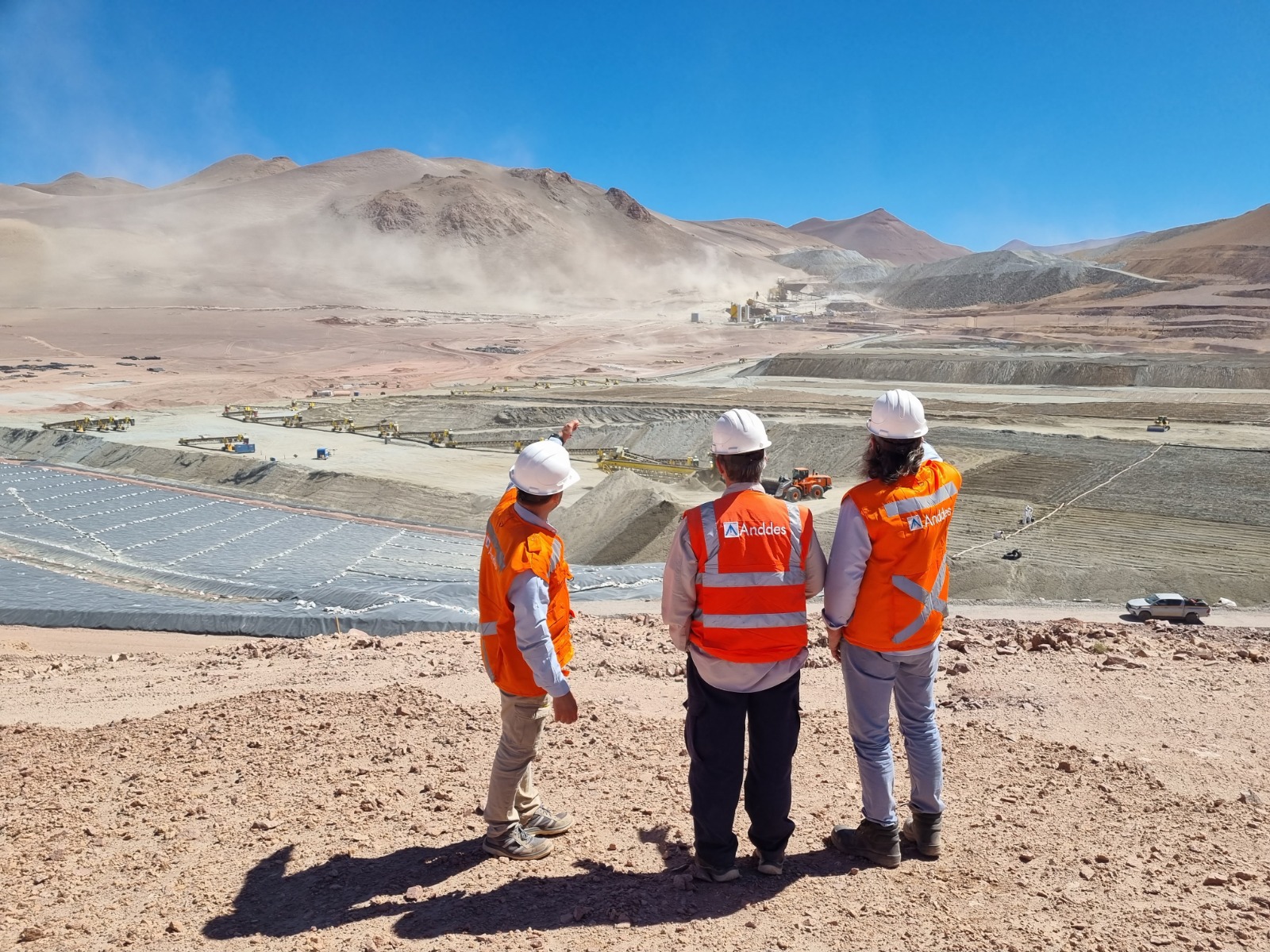
One of the essential geotechnical aspects in the design of leaching pads is related to the shear strength at the interface of the underlying geomembrane system, which isolates the leaching solution and the ore from the natural terrain. The conventional design of a lining system considers a double containment formed by a geomembrane (GM) on a compacted soil layer (SL). The overlaying material (OL) and the solution collection piping systems are placed on top of the GM. The OL is usually a granular soil that protects the GM and allows the solution to drain. The shear strength at the interface between GM and SL is generally estimated using a large-scale direct shear test (LSDS), which typically provides the maximum (peak) and post-peak (or residual) strength parameters. Slope stability analyses are performed conservatively, considering the lowest shear strength at the interface, corresponding to the residual strength. Usually, the results of the LSDS tests show that the GM-SL interfaces have the lowest post-peak and residual strengths. However, this assumption could be the opposite, since the minimum roughness height recommended for the textured geomembrane is 0.4 mm, according to GRI-GM 17 (GRI, 2021a). The limit equilibrium method (LEM) is commonly used to evaluate the stability of a leaching pad. In this method, the interface is modeled as a continuous element (similar to a thin layer of soil). The most widespread and accepted analysis criterion in practice generally assumes that the mobilized shear strength reaches or exceeds the maximum strength of the materials; therefore, post-peak strengths are usually considered in stability analyses. However, this criterion can be very conservative when estimating the safety factor (FS). This article proposes empirical formulas to estimate the maximum and post-peak shear strengths of the GM-SL interface, based on the roughness height of the GM and the classification of the SL (USSC). Likewise, empirical formulas are proposed for the OL-GM interface based on the gravel content of the OL. Furthermore, this research suggests using the maximum strength for the flat areas and the post-peak strength for the stepped areas in the static slope stability analysis of leaching pads.