This study evaluates the performance of a filtered tailings storage facility (FTSF) partially constructed with uncompacted tailings, to be presented at the Tailings and Mine Waste 2024 conference, to be held in Denver, Colorado, USA, from November 10 to 13, 2024. The research, developed by our geotechnical experts Edwin Sanchez and Denys Parra from Anddes Peru, explores the advantages and challenges of using filtered tailings, with a particular focus on reducing operating costs while ensuring structural integrity.
Filtered tailings are generally compacted after reducing their moisture content; in general, the entire process entails high operating costs. This study proposes a dual-zone design for the FTSF: a structural zone composed of compacted tailings to ensure stability and a non-structural zone of uncompacted tailings.
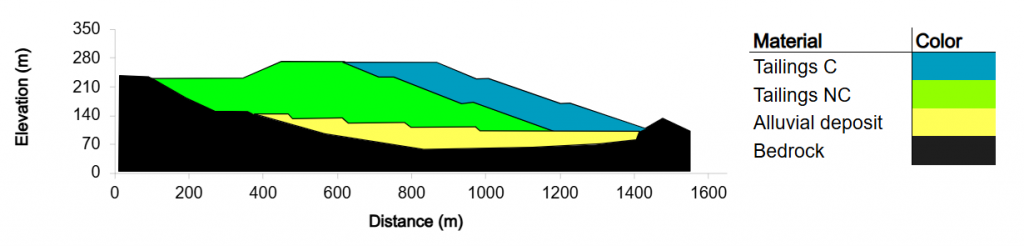
The behavior of the tailings was characterized through geotechnical investigations, including field and laboratory tests. In the initial stability analysis, the necessary length of the structural zone (compacted tailings) was determined to mitigate liquefaction risks, concluding that it should extend at least 250 m for the analyzed case. The investigation employed numerical modeling using the finite element method to simulate the static behavior of these materials, utilizing the NorSand model to analyze the non-compacted tailings.
Two cases were analyzed for the non-compacted tailings, the first with a moisture content equal to the moisture of the filtering process (20%) and the other with drying to the optimum moisture (16%). The simulation results indicated that for the first case, the increase in saturation due to the self-weight of the tailings generated excess pore pressures and static liquefaction of the non-compacted tailings, so the management of the moisture content of the non-structural zone is of great importance, making it necessary to reduce the moisture content to the optimum value to avoid stability risks without significantly increasing costs.
These findings emphasize the practicality of non-compacted tailings to reduce operating costs, also highlighting the importance of adequate moisture management to ensure safe and stable performance in the DSRTF. Overall, this study provides valuable insights into engineering practices in tailings management, especially in relation to the sustainability and improvement of the safety of mining operations.