
Geolab
Our Geotechnical Laboratory, accredited under NTP-ISO/IEC 17025 and equipped with state-of-the-art technology, ensures precision and accuracy in every test. We deliver reliable results with competitive turnaround times, supported by a highly qualified team that provides specialized technical consulting.
All testing is conducted in accordance with international standards, including ASTM and ISRM, ensuring the quality and reliability of our results.
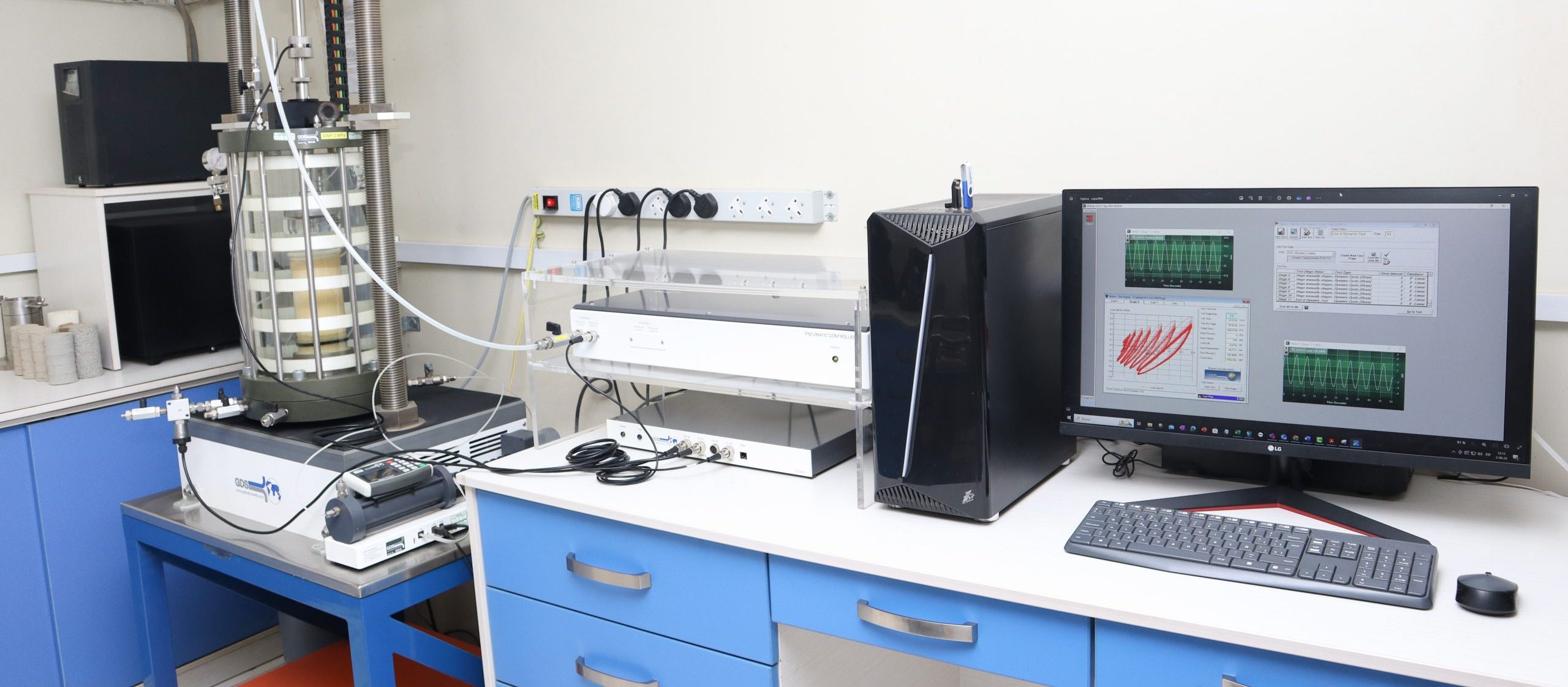
The RCTS (Resonant Column and Torsional Shear) apparatus allows for obtaining non-linear dynamic soil properties at low to intermediate strains. These dynamic characteristics include the determination of shear modulus and damping ratio curves relative to a given shear strain. The RCTS system enables two types of tests: the Resonant Column test and the Torsional Shear test.
The purpose of these parameters is to capture the actual non-linear soil behavior for the dynamic analysis of geotechnical structures. The equipment is designed to handle confining pressures of up to 1,400 kPa, depending on the material type.
These tests are applied to geotechnical structures such as leach pads, waste rock dumps, and tailings storage facilities (TSFs), among others. This equipment is the only one of its kind in Peru.
The Cyclic Triaxial System allows for a wide variety of tests to be performed on 2.8” and 6.0” diameter specimens:
- Soil dynamic properties, Young’s Modulus, and damping ratio (ASTM D3999): Capability to perform tests under either load or strain control.
- Undrained cyclic strength under load control (ASTM D5311): This test is suitable for evaluating soil liquefaction potential and also allows for post-cyclic monotonic testing.
- Resilient Modulus (AASHTO T307-99): Capable of performing tests on subgrade, base, and subbase materials.
- Anisotropic consolidation triaxial tests (K0): Capable of controlling vertical and horizontal stresses to apply anisotropic consolidation.
- Sieve analysis (ASTM D6913)
- Atterberg limits (ASTM D4318)
- Hydrometer analysis (ASTM D7928)
- USCS soil classification (ASTM D2487)
- Specific gravity of solids (ASTM D854)
- Standard and Modified Proctor (ASTM D1557, ASTM D698)
- Unit weight (ASTM D7263)
- Maximum and minimum index density (ASTM D4254/D7382)
- Consolidated Undrained (CU) Triaxial Test (ASTM D4767)
- Consolidated Drained (CD) Triaxial Test (ASTM D7181)
- Unconsolidated Undrained (UU) Triaxial Test (ASTM D2850)
- Critical State Line (CSL) Testing
- Unconfined Compression Test (ASTM D2166)
- Large-Scale Direct Shear Test (ASTM D5321)
- Flexible Wall Permeability Test (ASTM D5084)
- Rigid Wall Permeability Test (ASTM D2434)
- One-Dimensional Consolidation Test (ASTM D2435)
- Puncture Resistance Test
- California Bearing Ratio (CBR) (ASTM D1883)
- Expansion and Collapse Testing (ASTM D4546)
- Seepage Consolidation Test
- Soil-Water Characteristic Curve (SWCC) – Filter Paper Method (ASTM D5298)
- Physical properties (ASTM C97)
- Uniaxial Compressive Strength (UCS) (ASTM D7012)
- Triaxial compression testing for rock (ASTM D7012)
- Unconfined compression and elastic constants (ASTM D7012)
- Triaxial compression and elastic constants (ASTM D7012)
- Indirect tensile strength (Brazilian Test) (ASTM D3967)
- Point load strength index (ASTM D5731)
- Slake durability index (ASTM D4644)
- Determination of shear wave velocity ($V_s$), compression wave velocity ($V_p$), and dynamic elastic constants (ISRM)
- Direct shear strength of rock (ASTM D5607)
- Tilt test
- Rheology (Yield stress, viscosity, and solids content)
- Desiccation tray test
- Flume test
- Settling test for tailings samples
- Bleeding test